 Evie's Finds
Health Discovery
My Brother Tried to Quit Nicotine Pouches 5 Times. Here's What Finally Worked — And Why Nobody Warned Us It Would Be This Hard.
Plus: The research that explains why pouch users are nearly 3x more likely to fail at quitting than cigarette smokers — and what's actually helping thousands of people break free.
By Evie
Evie's Finds · Health & Wellness

Hi, I'm Evie.
I'm not a doctor. I'm not a researcher. I'm a 29-year-old from Leeds who spent the better part of three months obsessively reading every study, forum thread, and clinical paper I could find on nicotine pouch addiction — because my brother Jake was falling apart trying to quit, and nobody could tell us why.
This is what I found. And I genuinely think it could change everything for anyone stuck in the same loop.
The Switch That Was Supposed to Fix Everything
Jake is 34. He's been using nicotine in some form since he was 17. Cigarettes first, then vaping, then about two and a half years ago he made what he thought was the responsible switch: nicotine pouches. No smoke. No smell. No standing outside in the rain. He could use them at his desk, in the car, in meetings. His girlfriend stopped complaining. His clothes stopped smelling. He genuinely thought he'd solved it.
"I actually felt good about myself for about a week. Like I'd finally done the sensible thing."
Then he tried to stop.
What followed was the worst six months I've watched anyone go through. He couldn't sleep properly. He couldn't concentrate at work — his manager pulled him aside twice to ask if everything was okay. He described this constant background anxiety, like a low-level alarm that never fully switched off. He was irritable in a way that was hard to be around.
He tried cold turkey. Made it nine days the first time. Three the second. Eleven the third — that was his record — and then he caved on day twelve and felt like the most pathetic person alive. He tried nicotine patches. He used them for two weeks while also secretly using pouches, which he was too ashamed to admit until much later. He tried weaker pouches, stepping down gradually. Nothing worked.
Five attempts. Five failures. And every single time, he said the same thing:
"This is so much harder than quitting cigarettes was. Something is wrong with me."
I believed him. But I didn't understand why. So I started looking.
The Research That Made My Blood Boil
About three months ago, I came across a clinical study that I genuinely could not believe hadn't been covered more widely. A team of addiction medicine researchers tracked 1,400 participants across three nicotine dependency groups — cigarette smokers, vapers, and oral nicotine pouch users — over six years. They measured dependency scores, withdrawal severity, and quit attempt outcomes.
Their finding: pouch users had quit attempt failure rates nearly three times higher than cigarette smokers at the 90-day mark.
Three times. Not a little harder. Not marginally more difficult. Three times more likely to fail.
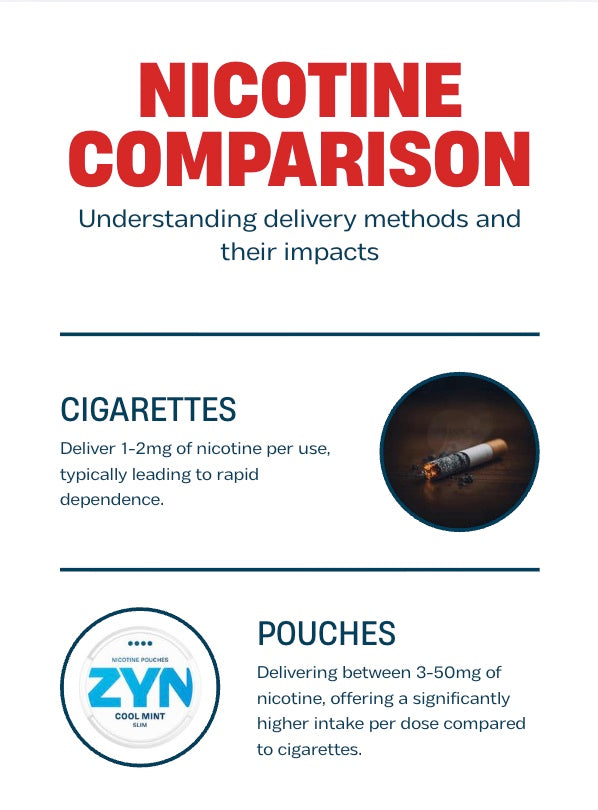
And the reason isn't what most people assume. It's not just that pouches contain more nicotine — though they do. A typical cigarette delivers 1 to 2 mg of nicotine. Nicotine pouches range from 3 mg to over 50 mg per pouch, absorbed directly through the gum tissue into the bloodstream with near-100% efficiency. But the deeper problem is how pouches change the pattern of use entirely.
The Invisible Addiction Nobody Talks About
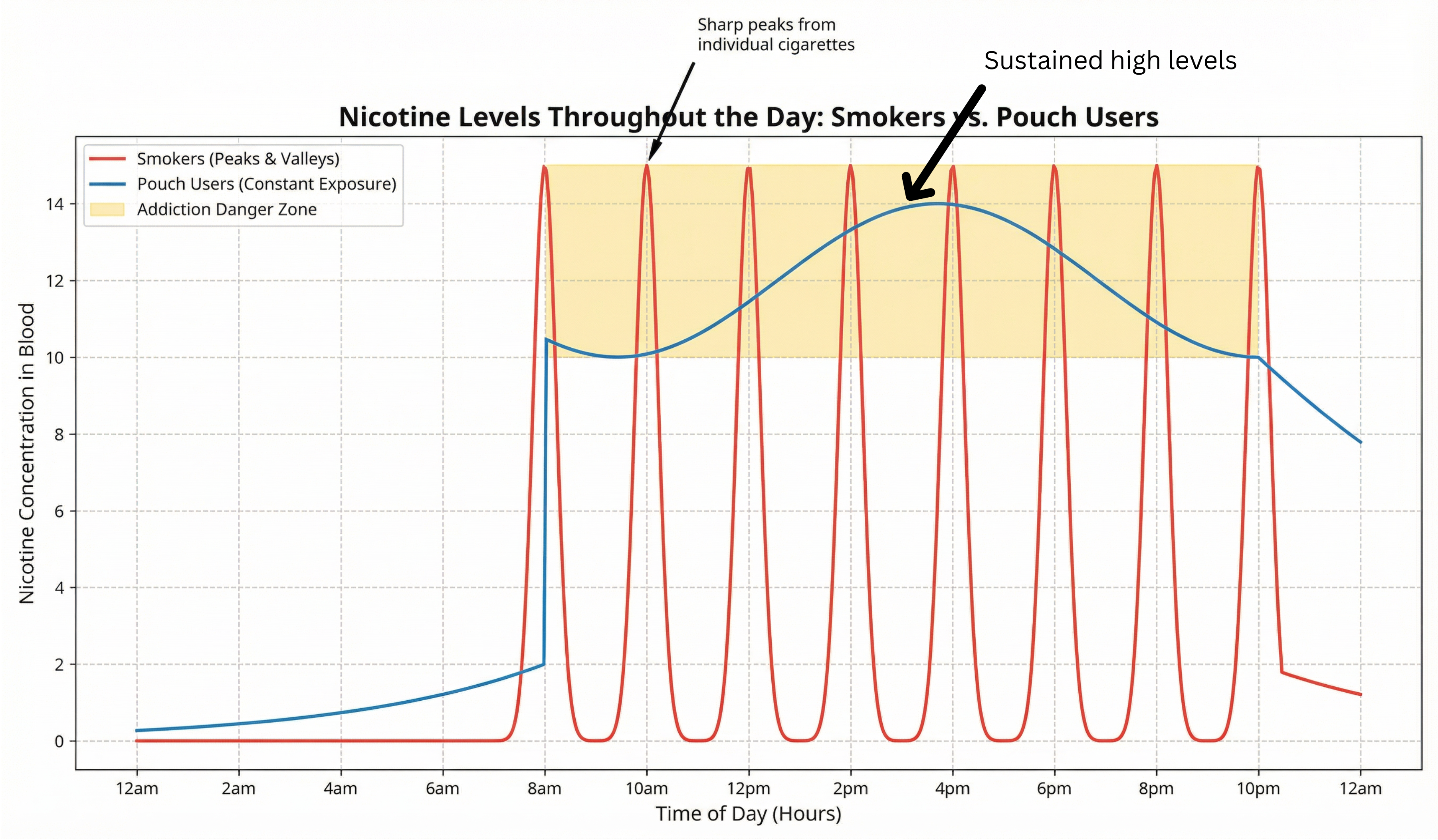
When you smoke a cigarette, your blood nicotine levels spike and then drop. You get a clear beginning and end to each dose. Your brain registers the cycle. There's also friction built into the habit — you have to go outside, you can't smoke in most places, people can smell it on you. Those external brakes, annoying as they are, actually help moderate how much you use.
Pouches have none of this. You can use them anywhere. At your desk. In a meeting. In bed. At the gym. On the school run. There's no smoke, no smell, no social consequence. And because the nicotine absorbs slowly through the gum and maintains elevated levels in your bloodstream for far longer than a cigarette, your brain never gets the clear "dose ended" signal. It just keeps asking for more.
The researchers described it as a "constant dosing cycle" — and it fundamentally rewires dependency in a way the up-and-down pattern of smoking never did. Even the lowest-strength pouches deliver more total daily nicotine than a pack of cigarettes when used throughout the day.
"With cigarettes, I knew when I'd had one. With pouches, I never felt like I'd had enough."
That sentence haunted me when I read the research. Because it's not just a feeling. It's pharmacology.
What Withdrawal Actually Does to Your Body
This is the part that I think most people — including me, before I started researching — completely underestimate.
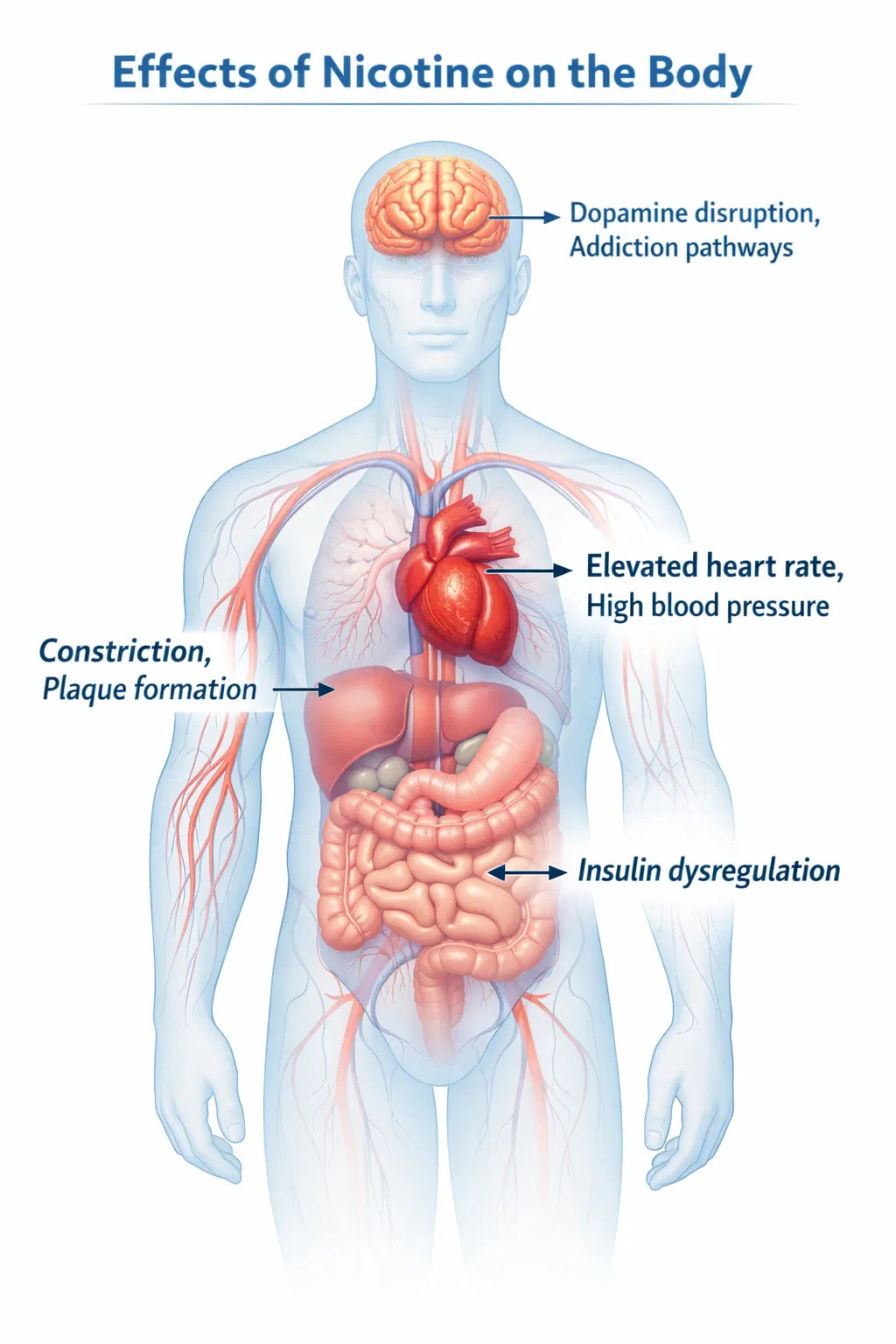
When you've been using nicotine pouches heavily, your body stops producing certain things naturally. It outsources them to the nicotine. Energy — your brain stops relying on natural cellular energy production and starts depending on nicotine's stimulant effect instead. Focus — your dopamine system restructures itself around nicotine hits. Stress regulation — nicotine becomes your primary coping mechanism. Metabolic function — nicotine affects insulin regulation, keeping blood sugar artificially stable.
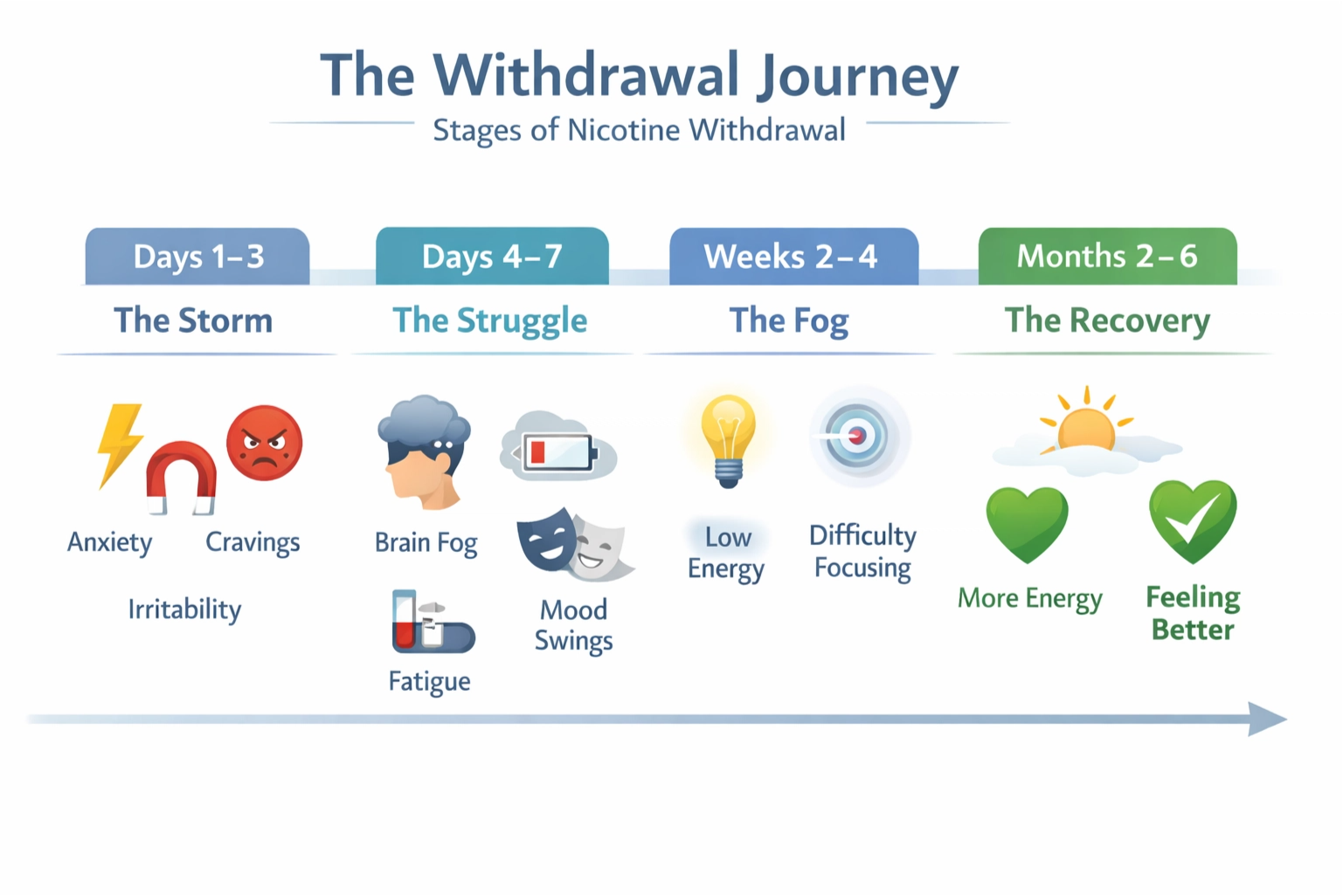
When you suddenly take all of that away, your body doesn't automatically remember how to do these things on its own. That's why withdrawal from pouches isn't just cravings. It's brain fog so thick you can't think at work. It's fatigue that makes getting off the sofa feel impossible. It's anxiety with no obvious cause. It's an emotional flatness — a grey — that can last for weeks or months.
"I'm on day three of stopping and my heart already feels better. But the mental part is no joke."
Jake called week two "feeling like someone had turned the colour off." He wasn't being dramatic. The research describes exactly this: dopamine disruption from heavy pouch use can take months to fully normalise. Some users report effects lasting six to eight months after stopping.
"I used 15 mg pouches for four years. Stopped nearly eight months ago and it still isn't easy. The dopamine shift these things create is remarkable."
Why Everything Jake Tried Failed
Once I understood what was actually happening in his body, it became obvious why every conventional approach had failed.
Nicotine patches and gum were designed for cigarette smokers. They work by delivering a lower, steadier dose of nicotine to ease physical withdrawal while you break the habit. But for pouch users, the dependency level is already so much higher that patches can't bridge the gap. And more importantly, they don't address the real problem: they don't help your body relearn how to produce natural energy, regulate dopamine, or manage stress without external chemicals. They just extend the dependency in a different format.
"My mother died of heart-related issues after being on nicotine gum for 15 years. They were wrong when they said it was just expensive."
Cold turkey ignores the neurological reality entirely. "Just stop" sounds simple when the obstacle is a habit. When the obstacle is an altered brain chemistry that has taken over your energy production, focus, and emotional regulation — willpower alone isn't enough. Jake isn't weak. His brain had been genuinely restructured.
"You've got to realise you're completely addicted to a strong substance that has literally changed the way you think and act. Your brain rewires when you stop."
Stepping down gradually with weaker pouches just prolongs the process without ever breaking the cycle. And the social environment makes it worse — pouches are trendy, marketed as harmless, offered casually. Stopping feels like you're missing out rather than making a healthy choice.
"Zyn is running a campaign called the 'Zyn10 Challenge' — try it for 10 days for £20 off. Probably just long enough to get you addicted. No clue how this is legal."
None of these approaches address what Jake's body was actually missing. They all try to manage the symptom — the craving — without restoring the underlying systems that nicotine had taken over.
What Your Body Is Really Craving
Nicotine doesn't actually give you energy, focus, or calm. It temporarily relieves the withdrawal symptoms it created in the first place.
Non-users don't need nicotine to focus, stay calm, or have energy throughout the day. Their bodies produce these naturally. When you've been using heavily, your body has outsourced all of it:
•Energy production — Instead of natural cellular energy, you rely on nicotine's stimulant effect
•Focus and clarity — Your dopamine system depends on nicotine hits
•Stress management — You've lost touch with your natural calm state
•Metabolic function — Nicotine has been artificially regulating your insulin and metabolism
"When you're a nicotine addict, it convinces you that it calms you down. The calming effect is just the ending of withdrawal between uses. The nicotine was actually contributing to my stress the whole time."
Real People, Real Breakthroughs

"I tried quitting pouches four times. Each time, the withdrawal was so bad that I gave up within days. Then I found something that actually addressed what my body needed. The difference was night and day. I'm 8 months free now."
"After 4 years on Velo's, I thought I'd never escape. The brain fog and fatigue when I tried to quit were unbearable. Having something that supported my natural energy production made all the difference. I actually feel GOOD now."
"I've quit harder drugs than nicotine, but nicotine was winning until I stopped fighting my biology and started supporting it. Game changer."
What Finally Worked
I want to be careful here, because I'm not making medical claims and I'm not a healthcare professional. But I can tell you what Jake found, and why it made sense given everything I'd read.
The approach that finally worked wasn't about suppressing cravings or replacing nicotine with something else. It was about supporting the systems that nicotine had hijacked — helping his body relearn how to produce natural energy, restore dopamine function, regulate stress, and maintain focus without relying on an external chemical.
He found Mystic's HEX — a nootropic energy pouch with zero nicotine. Not a nicotine replacement. Not a patch or a gum. A science-based formula designed specifically to support the neurological and metabolic functions that heavy nicotine use disrupts:
🧠
Dopamine & Neurotransmitter Support
Natural compounds that help restore the reward pathways nicotine has disrupted, reducing cravings and mood swings.
⚡
Clean Cellular Energy
Real energy production at the mitochondrial level — not the fake jolt and crash of stimulants, but sustained natural energy.
🎯
Mental Clarity & Focus
Support for cognitive function without relying on external chemicals, helping you think clearly through withdrawal.
😌
Stress Response Regulation
Adaptogenic support that helps your body manage stress naturally, the way it did before nicotine took over.
💪
Metabolic Balance
Ingredients that support healthy insulin function and metabolism as your body recalibrates.
The first ten days were still hard. Jake is honest about that. But for the first time, the withdrawal felt manageable rather than impossible. The brain fog lifted faster. The energy came back. The anxiety didn't spiral the way it had on every previous attempt.
He got through day twelve. Then day twenty. Then thirty.
"It's the first time I've ever tried to quit something and felt like I had the right tool for the actual problem."
He's been completely free for four months. He still uses HEX occasionally when he needs focus or energy, but he's not dependent on it. He doesn't feel like something is missing.
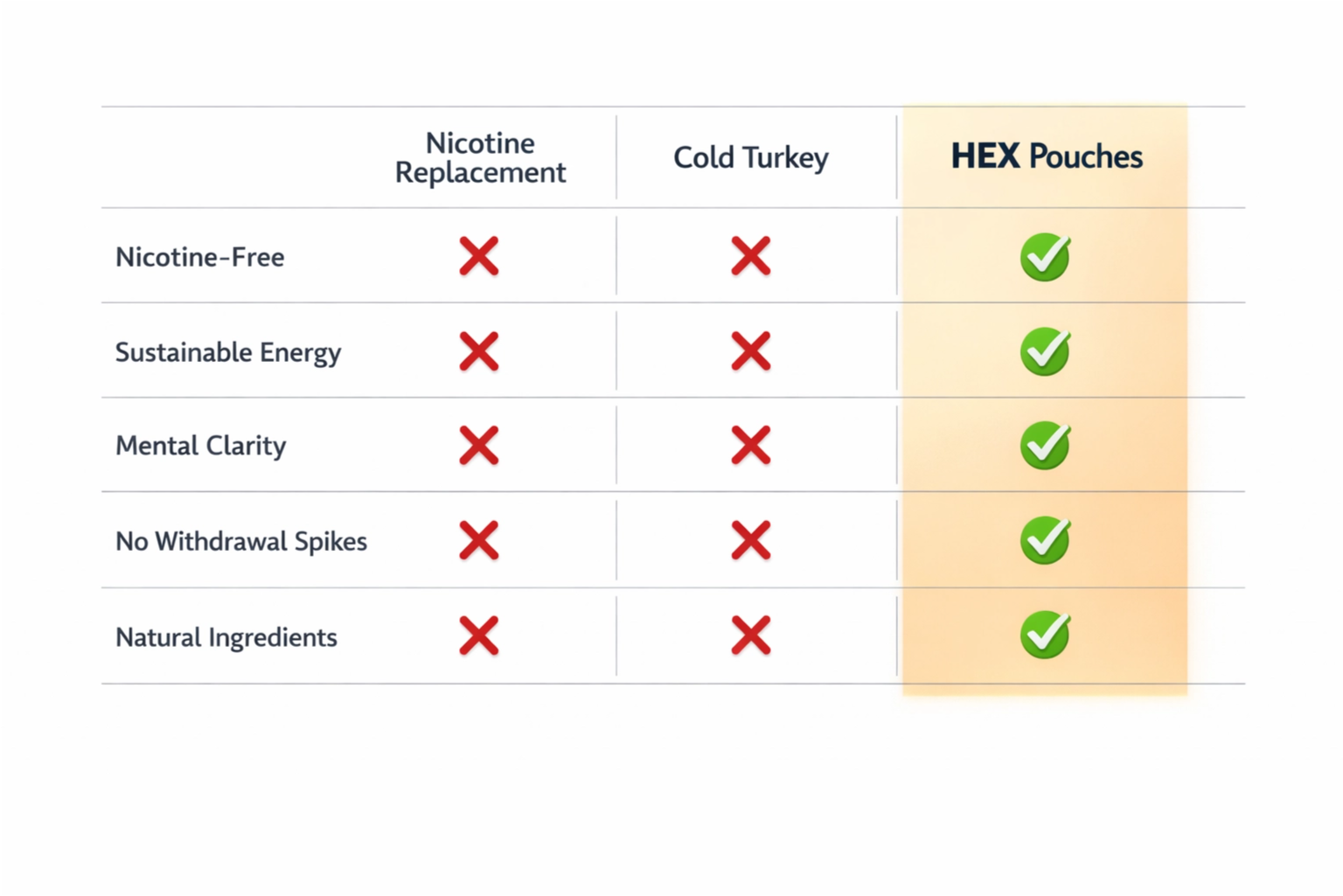
How It Works: The 30-Day Roadmap
✓
Days 1–10: The Crisis Phase
This is when withdrawal hits hardest. Mystic's HEX provides the energy, focus, and mood support your body is screaming for, making the unbearable... bearable.
✓
Days 11–20: The Stabilisation Phase
Your body starts remembering how to function normally. Cravings decrease. Energy stabilises. You start feeling human again.
✓
Days 21–30: The Liberation Phase
Your natural systems are coming back online. You notice you're not thinking about pouches constantly. The grip loosens. Freedom feels possible.
✓
Beyond 30 Days: Your New Normal
97% of users continue with Mystic's HEX for 2–3 months as their body fully recalibrates. By then, they're not just 'not using pouches' — they're thriving.
The Two Choices
If you're reading this and you're in the loop — trying, failing, hiding it, trying again, feeling like something is wrong with you — I want you to know: nothing is wrong with you. You're using a product that was specifically engineered to be harder to put down than what you left behind. The research proves it. The failure isn't yours.
But you have a choice right now.
You can close this page and try the same things again. Cold turkey. Patches. Weaker pouches. The same approaches with the same failure rates. And in three months, you'll be back where you are now — or worse.
Or you can try something that was actually designed for what pouches do to your brain. Something that addresses the real problem instead of just managing the symptom.
Join 6,000+ People Who've Already Broken Free
Use code BREAKFREE for 20% off · 30-day money-back guarantee
CHECK AVAILABILITY →Join the 6,000+ Who've Already Broken Free
Mystic's HEX is currently offering 20% off with the code BREAKFREE, and it comes with a 30-day money-back guarantee. If it doesn't help, you pay nothing. You have nothing to lose except the thing that's been controlling you.

CHECK AVAILABILITY — USE CODE BREAKFREE FOR 20% OFF
30-day money-back guarantee · Free shipping on orders over £30
THIS IS AN ADVERTISEMENT AND NOT AN ACTUAL NEWS ARTICLE, BLOG, OR CONSUMER PROTECTION UPDATE. Evie's Finds is a health and wellness discovery page. Individual results may vary. The information provided is for educational purposes only and does not constitute medical advice. Always consult a healthcare professional before making changes to your health routine.