The "Harmless" Habit That's Quietly Destroying Your Dopamine System
Millions of people switched to nicotine pouches thinking they were making the smart, healthy choice. They weren't. Here's what's actually happening inside your brain — and why 6,000+ people have already made the switch to something better.

Picture this: It's 7:14am. Your alarm went off twelve minutes ago. Before you've checked your messages, before you've had a sip of water, before you've done anything — your hand is already reaching for the tin on your bedside table. You don't even think about it. It just happens.
That moment — the automatic reach — is not a personality flaw. It's not a lack of willpower. It's the result of a chemical process that your nicotine pouches have been quietly running on your brain for months. And the worst part? You thought you were being responsible. You'd already quit smoking. You'd already ditched the vape. The pouch was supposed to be the safe option.
"I tried to use nicotine as a nootropic and intended to have strict limits with using it. I found myself craving more and more and decided I need to stop now before I can't."
Here's what nobody told you when you picked up your first Zyn or Velo: modern nicotine pouches deliver up to 50mg of nicotine directly into your bloodstream — with 100% absorption efficiency. A cigarette delivers roughly 1–2mg. You are not using a gentle alternative. You are using something that is, gram for gram, one of the most potent nicotine delivery mechanisms ever created.
nicotine absorbed
nicotine absorbed
straight to bloodstream
The Dopamine Crash: Why You Can't Feel Normal Without It

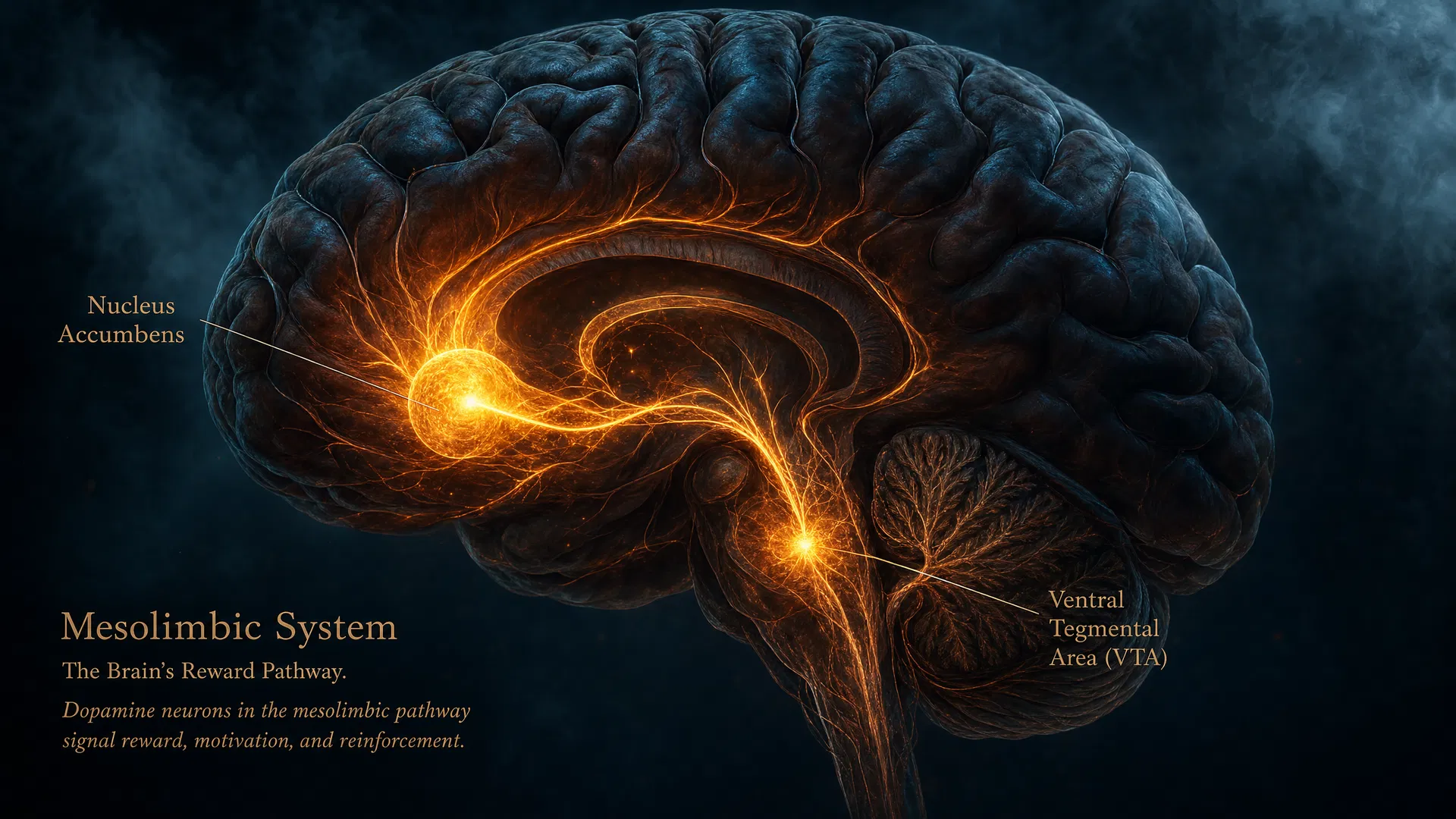
When nicotine enters your bloodstream, it triggers a massive, artificial release of dopamine — the brain's reward chemical. It feels like clarity. Like focus. Like you've unlocked a better version of yourself. That feeling is real. But it comes at a price your brain is quietly paying in the background.
Every time nicotine forces that dopamine dump, your brain registers the pattern: external substance → reward. Over time, it stops producing dopamine naturally at the same level. Why would it? The pouch is doing the work. The result is what neuroscientists call a "baseline shift" — your brain's new normal is a state of dopamine deficit. Without the pouch, you don't feel good. You feel less than normal.
The science is unambiguous. Research published in peer-reviewed journals has shown that long-term nicotine use decreases stimulated dopamine release in the nucleus accumbens — the brain's core pleasure centre — by approximately 70%. Your brain has been quietly dismantling its own ability to feel good, one pouch at a time.
"That dopamine high that I once thought was helping me, is now something my brain craves and struggles to function without."
Sound familiar? Here's a checklist of what the baseline shift actually feels like day-to-day. Read it honestly:
The financial reality is just as brutal. A moderate nicotine pouch habit runs £120–£200 per month. That's up to £2,400 a year — spent on a substance that is actively degrading your cardiovascular system, your sleep quality, and your brain's ability to generate its own happiness.
Why Everything You've Already Tried Has Failed
It's not your fault. The system is genuinely rigged against you. Here's why every conventional exit route is a dead end.
Cold Turkey
The withdrawal isn't just discomfort — it's a neurological crisis. Brain fog, depression, fatigue, and time-perception distortions can last weeks. Your brain has literally rewired itself around nicotine. Removing it abruptly is like pulling the power on a running machine.
"Yeah quitting nicotine pouches is harder for me than the times in my life I've quit smoking. I made the mistake and thought quitting Zyn would be similar."
Nicotine Patches & Gum
They address the chemical addiction but completely ignore the physical habit. The ritual of popping a pouch under your lip is as powerful as the nicotine itself. Patches cause violent itching rashes. Gum causes hiccups so severe they're almost painful. And neither gives you any cognitive benefit.
"Patches itch like hell. Gum gives me hiccups so bad I nearly choke. And I still reach for a pouch."
Vaping
You already know this one. Within two weeks of switching, users report their lungs feeling raw and scorched. You're not quitting nicotine — you're just changing the delivery mechanism and adding new damage.
"I tried vaping to quit pouches. I truly regret it. Within two weeks my lungs felt like they were scorched."
Willpower Alone
Willpower is a finite resource that nicotine addiction specifically targets. The addiction has literally changed the way your brain processes reward. You're not fighting a bad habit — you're fighting a chemically altered reward system.
"I've quit heroin, cocaine, meth, pain pills — you name it. Nicotine is the hardest for me."
The reason all of these fail is the same: they address either the chemical addiction or the physical habit — never both simultaneously. Until you solve both problems at once, you will keep failing. Not because you're weak. Because the solution doesn't exist yet in what you've been trying.
"I Was Hiding It From My Wife. I Didn't Even Realise How Far It Had Gone."
Tom, 38, works in finance in the City. He started on Velo 6mg about two years ago — "just to get through earnings season," he told me. Within three months he was on 11mg pouches, going through a tin every day and a half. He'd tried to quit cold turkey twice. Both times he lasted four days before the brain fog became unbearable at work.
"The thing that got me wasn't the cravings," he said. "It was the fact that I couldn't think properly without one. I was hiding the tins in my desk drawer at work. My wife thought I'd quit months ago. I'd go to the bathroom just to pop one in. That's when I knew it wasn't a habit anymore — it was something else."
Tom found HEX through a Reddit thread on r/QuittingZyn. He was sceptical — "I thought it was just another gimmick" — but the physical ritual was the thing that convinced him to try it. "I needed something to put under my lip. That was non-negotiable. I'd tried patches and they just made me angrier."
Three months later, Tom's resting heart rate is down from 88 to 71. He told his wife. He doesn't use the bathroom at work to sneak a pouch anymore. "The first two weeks were still hard," he said. "But by week three, I started waking up and not immediately reaching for the tin. That was the moment I knew something had actually changed."
What If You Didn't Have to Give Up the Ritual to Get Your Life Back?
Imagine waking up at 7am and your first thought isn't about the tin on your bedside table. You make a coffee. You check your phone. You get in the shower. The morning just happens — without the automatic reach, without the low-level guilt, without the calculation of how many pouches you have left.
Imagine sitting in a meeting and realising, halfway through, that you haven't thought about nicotine once. Not because you're white-knuckling it — but because you simply don't need it. Your brain is producing its own focus. Your own energy. Your own calm.
That person is still there. Your dopamine system hasn't been permanently broken — it's been suppressed. And it can come back. The research is clear: given the right conditions, the brain's reward pathways normalise. The question is what those conditions look like.
The breakthrough insight is this: you don't need to white-knuckle your way through withdrawal while simultaneously fighting the urge to put something under your lip. Those are two separate battles. And you can win one of them immediately.
What you need is something that satisfies the physical ritual — the familiar weight under the lip, the activation, the sense of doing something — while simultaneously giving your brain the raw materials it needs to start rebuilding its own dopamine production. Not a patch. Not gum. Not willpower. A replacement that is genuinely better.
"From what I've found, people who are aware of the side effects look for alternatives where they can still blend in with a pouch — without the harm."
Mystic's Energy HEX Nootropic Pouches
The world's first nootropic pouch designed to satisfy the physical habit, restore natural dopamine production, and deliver clean, sustained cognitive energy — with zero nicotine, zero tobacco, zero cardiovascular stress.
The Science of HEX: Why It Actually Works
Each ingredient has been chosen to directly counteract a specific mechanism of nicotine damage. This isn't a wellness blend — it's a targeted biochemical response.
Provides the brain with the precursors it needs to synthesise dopamine naturally. L-Tyrosine is the direct amino acid precursor to dopamine — research has shown it supports dopamine synthesis under cognitive stress (Colzato et al., 2013). Alpha-GPC supports acetylcholine production, reinforcing the cognitive clarity that nicotine artificially mimicked.
Forces an artificial dopamine dump. Over time, the brain stops producing dopamine naturally, creating a permanent deficit — a 70% reduction in stimulated dopamine release documented in peer-reviewed research.
Delivers smooth, focused energy that activates in 15–30 seconds and sustains for 30–60 minutes. L-Theanine modulates caffeine's stimulant effect, eliminating jitters and anxiety entirely. The combination is one of the most studied cognitive stacks in nootropic research.
Creates cardiovascular stress, elevated heart rate, palpitations, and anxiety. The energy is borrowed — you pay it back with a crash and a craving.
Zero strain on the heart. Users report resting heart rates dropping significantly within weeks. No vasoconstriction. No atherosclerotic plaque formation. No nicotinic receptor upregulation.
Constricts blood vessels, promotes plaque formation, elevates resting heart rate, and disrupts sleep architecture. Cardiotoxic even without tobacco.
Same discreet under-lip placement. Same 15-second activation. Satisfies the physical habit completely while the brain rewires away from nicotine dependency. You fight one battle, not two.
The physical habit is as addictive as the chemical. Any solution that removes it forces you to fight two battles at once — and most people lose.
6,000+ People Have Already Made the Switch
This is what life looks like on the other side. Not white-knuckling withdrawal. Not trading one addiction for another. Just waking up and feeling like yourself again.

"My resting heart rate dropped from 92 to 68 within three weeks of switching. I didn't even realise how much the pouches were stressing my heart until I stopped."

"I kept the ritual — the pouch under my lip — but the anxiety just stopped. It's been four months and I genuinely don't think about nicotine anymore."

"I was spending £180 a month on Zyns. Now I'm spending £30 on HEX and I'm saving over £150 every single month. It sounds too simple but it's true."

"The focus is real. Not the fake nicotine focus that disappears the moment the pouch is out — actual, sustained clarity that lasts through the morning."
What You're Currently Spending vs. What You Could Be Spending
Most HEX customers spend £28–£35 per month. That's roughly £150 less than the average nicotine pouch habit — every single month. Over a year, that's nearly £1,800 back in your pocket, and a dopamine system that's rebuilding itself rather than being dismantled.
Your Brain Is Waiting to Heal.
The Only Question Is When.
Every day you wait is another day your dopamine system is being depleted. Another £6 spent on something that's making you worse. Another morning reaching for the tin before you've even opened your eyes.
🔒 Secure checkout · 30-day money-back guarantee · Free UK shipping